Here are some interesting, if not exactly uplifting, statistics from agent Suzie Townsend regarding # of queries vs. # of offers she made.
Basically, of 5.530 writers who queried her within ten and a half months (a staggering number in itself, IMO, seeing as it's approximately 18 queries per day), she offered representation to sixteen. Which is probably quite a lot for a single agent, but put into more numbers means she was willing to take on 0.2% of all people who queried her.
*swallow*
Why on Earth do I believe that my novel is even close to good enough to get into those 0.2%?!
After an initial panic attack, accompanied with loss of all hope and the five-minute consumption of two bars of milk chocolate, I realized there are several not-to-be-overlooked factors that gave me back hope.
First of all, just because one agent doesn't like your material, doesn't mean another won't. There are a lot of agents out there, and if I've given it my all, and my book is supposed to make it into the published world, I will find the right agent for it sooner or later.
Secondly, I define when I've given it my all. I can call it quits if I don't snag an agent after the tenth revision. Or the twentieth. Or the fiftieth. It's up to me when I bury my pulishing hopes for my book. Of course, making it the best it can be for the first round of querying is the best thing to do. But sometimes a little time and distance, or an agent who read a partial or even the full ms but then said "sorry, not for me" can add a new perspective, make me see ways to improve again. And again. Until I know for myself that this story is never going to be found on a shelf in a bookstore with a legitimate publisher's brand on the cover, I can keep going.
(On a side-note: I don't mean to say I'd send my fiftieth revision to the same agent I've sent it to the other 49 times! That's why I send out queries a few at a time. Staggering the queries is the key, so that when you get good feedback or the inspiration faery hits you over the head with her idea-stick, you still have enough agents to send your new version to up your sleeve.)
Thirdly, if not this book, then maybe my next one will make it. Since I mostly write for the enjoyment of writing, creating worlds, developing characters, there's always going to be a next book for me. Even if it's only a new one every two years, even if I currently only have one to shop around.
There will always be a next book. And my writing will improve with every one. So chances are good that one of my stories will wow an agent and/or an editor one day.
Still, it's a good thing there aren't any exact numbers to be had on that chance. For now, I'm content with doing what I enjoy most.
Writing.
... where I post about my experiences as an aspiring author - from writing and editing, over querying agents and looking for a publisher, to things that really help(ed) me on my way. I'm looking forward to this unpredictable journey.
Tuesday, December 28, 2010
Monday, December 27, 2010
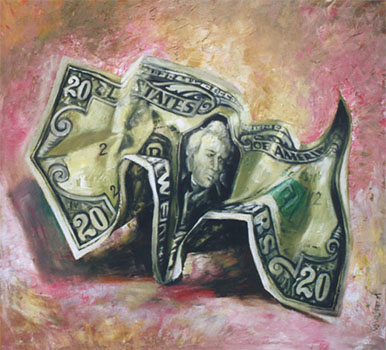
A $20 Bill - Value Of Our Lives
What a beautiful post to remind us that we are always worth the same - priceless - in God's eyes, no matter how low we've fallen, how worthless we seem to ourselves. He loves us, unconditionally, unequivocally, completely.
Thank You for that!
Thank You for that!
| Karel Novosad |
Saturday, December 25, 2010
White Christmas
We're having a beautiful white Christmas! The first I can truly remember. And it's not just a little powder dusting, either.
| Our back yard this morning |
| The town of Backnang, where I grew up |
Thursday, December 23, 2010
What Rudolf Can Teach Us
Everybody knows Rudolf the red-nosed Reindeer's story. Here's a very short summary.
Rudolf was different. The other reindeer laughed at his glowing red nose and didn't take him seriously. Until one day Santa spotted Rudolf, and recognized this reindeer's potential as guiding-light for his sleigh, and Rudolf was granted the great pleasure of being Santa's top dog - err, deer. From then on the other reindeer loved Rudolf. And he did go down in history.
What does this little story show us?
There are many ways to be different in life. Being eccentric, having same-sex tendencies, walking around barefoot even in winter, talking to trees, not wanting to be rich, not shaving, doing extreme-sports, not wanting children... basically anything that varies from the norm. But what exactly is the norm? To me, 'the norm' is a very fluid concept. And the best thing about it: you can define it for yourself. It doesn't matter what others' versions of the norm are. So long as you like and know the strengths of your red-glowing nose (there are always good things about being different, and not just because the world would be boring otherwise) you can enjoy it.
Your difference can make you shine - if you let it. It makes you an individual, makes you stand out from the norm. You are wonderful, you are beautiful, you are awesome. The others will catch on to your awesomeness sooner or later. As Santa and then the 'normal' reindeer did with Rudolf's. Just don't try to hide it. Santa would never have discovered Rudolf if he'd smudged dirt over his nose. You are worth being loved both in spite and because of your differences. They make you you. And knowing who you are is cause for a celebration, because so many people these days are lost in their lives, trapped by the confinements and demands of society.
Define your own demands for your life. Define your own norms. Stay true to them. Then you'll be free of them. And happy.
Merry Christmas!
| Link |
Tuesday, December 21, 2010
In It For The Long Wait
Well, that was easy enough. In response to my email about being unable to grant her an exclusive at this time (see previous post), Ms. Agent #2 asked me to send it anyway, so long as I let her know when/if I receive an offer, and not to make a decision until I do so.
I agreed, of course, and sent her the first three chapters immediately. Now all that's left for me to do is wait. Good thing I have my master thesis and my next work-in-progress to keep me occupied, or else I'd probably chew my nails down to the quick.
On another note, both agents 'passed' the Preditors and Editors check with flying colors. I did some research on them before I queried them, of course, and they seem reputable and trustworthy. P&E is a great site for confirming that impression. Unfortunately, it seems P&E is currently being sued, though it isn't specified on the site what exactly for, just that somebody wasn't happy about P&E giving out information they'd prefer to keep hidden from writers. Theoretically, that can only be one of the preditors, right? But you never know. There are, after all, a lot of shades of gray between black and white, and I definitely can't claim to know what's going on there. So I'll just say that I hope P&E will not have to close down as a result of this prosecution.
Monday, December 20, 2010
Another Request - Exclusive Submission
So this morning I mailed off the partial submission an agent requested last week, complete with SASE and hopefully enough US stamps for it to arrive back here sooner or later. My awesomely wonderful distant US relatives whom I met on Sunday brought me a whole stash of forever-stamps, no charge. THANK you!
And the best of luck to you, my first three chapters. Make me proud.
Other than sending off the partial, my day wasn't good. It wasn't bad exactly, it was just one of those why-bother days. Why bother taking an umbrella when cars sloshing through the street are just going to spray you from beneath? Why bother trying for the umpteenth time to make light of the same social network analysis software that has been nya-nya-nya-ing you for the past three days? Why bother eating yummy food you can't taste and which hurts your throat on the way down?
And then, this evening, half an hour ago, I get another email. From another agent. Who wants another first-three-chapters submission. This time via email.
Squeeeeeee! Now I'm definitely...
There is a... well, not a catch, exactly. More of a snag. This agent requested a three-week exclusive. Obviously, now that I sent my material to another agent just today, I can't grant her that. But I don't want to begin a possible agent-author relationship with a lie by telling her this is an exclusive, either. I also don't want to not send her my material. In fact, I want to send it to her very badly.
A classic dilemma. One I couldn't solve without more information.
Once again I turned on my trusty googlopedia (incidentally, how did people deal without the internet and stay sane?), and surfed the net for advice on this kind of situation. There's quite a lot, since I'm not the only one this has happened to (not that I'd expected that).
Here's the suggestion I liked most and used, a little altered, to answer Ms. Agent #2:
"Other agents are currently reading the proposal and another is reading the manuscript, so I'm unable to grant an exclusive at this time. I'll be happy to send the material on to you anyway, and should I receive an offer, I'll contact you before making any decision."
I hope she says, 'sure, I'll look at it anyway'. Mainly, though, I'm extremely grateful. Another submission request in one and a half weeks! This means I'm on the right track, that my query's getting agents' attention.
And I know that my novel matches - nay, surpasses - the query and will find somebody who'll want to represent it. Even if it's neither of these two agents.
Thursday, December 16, 2010
Pantsers And Plotters
The following topic has been coming up a lot in author and blogs lately: what is it better to be as an author, a pantser or a plotter? Is one or the other easier/harder? Pros and cons of the two? I've evolved into sort of a mix, which is why I thought I'd blog about this subject a bit.
| J.K. Rowling's Plot Outline OOTP |
Here's a guide to plotting like J.K. Rowling.
A pantser is an author who just starts writing based only on a single idea about plot, character or world building, without a clue about plot, characters and their development past this initial idea – these develop as the author delves further into the story, flying by the seat of his/her pants. Ergo, pantser. Apparently, Stephen King is a pantser. Since I haven’t read any of his books, I can’t really judge whether this is noticeable or not.
I used to be a complete pantser. I’d get an idea in my head, and would have to write about it. Hundreds of pages developed from there; wonderful characters, intriguing worlds, twisted plots – that usually ended up petering out and disappearing in the Quicksand of No Solutions.
Even with the first (and so far only) book I’ve finished, I started with nothing but an idea for the world and a possible character in it. The plot developed quickly, spreading off in several different story arcs, with characters introducing themselves left and right. By somewhere around 100.000 words, I had about five plot threads, twenty ‘important’ characters, and – once again – no solution to the problems.
My love for the main characters and the world I’d created, and the effort already invested in this project, stopped me from abandoning it. I vowed that I would finish this story, even if it was the last one I ever wrote. And believe me, there were times when I was ready to take another vow to never to start writing again once this was done.
Because I knew I couldn’t keep going the way I had been – no clue, meant no solution, which meant to ‘The End’ – I sat down and thought about what I had so far, what I wanted to happen on a grand scale (world), and how I wanted my characters to develop. I wrote these things down, then brainstormed possible plots to get where I wanted to go. And, surprisingly, wonderfully, several story threads suddenly fell into place, as if that was how they were meant to be all along.
I wrote down the key points, twists and turns that would take me to ‘The End’, then continued writing. When I was done, I had >140.000 words, meaning it took me only 40k to finish once I’d ‘plotted’; most of which was at least usable in its basic form, whereas a lot of the first 100k I had to erase completely – I mean, several whole story threads weren’t relevant anymore.
This made me realize something. Pantsing is great to get things started. But it’ll only get me so far. And it means a lot of work for me once the first draft is complete, because a lot of things that seemed important to me in the beginning, simply isn’t necessary.
Which is why, with the new novel I’ve started and intend to finish (again because I love the world and adore my characters), I wrote out the baddy’s intentions, the heros’ hopes and dreams, relationships and trials, as well as the world’s premises. Within these boundaries, the plot almost played out by itself, and I wrote it down, too. So I knew a lot about my characters, world and plot before I actually started writing – and I’ve found that it’s a lot easier to write along the plot already mapped out in front of me.
I did make sure of one thing while jotting down the plot: I didn’t make it too detailed, but kept to the basics, the bones if you will, of the story. This way it doesn’t get boring – and things aren’t set in stone, which is important for me, too. I enjoy it when my characters surprise me, or events happen that I hadn’t foreseen, things I have to deal with in a way that will keep me going in the general direction I’m heading in.
I once compared writing a novel to making a new friend; now I’m comparing it to life itself: it’s nice to know what you’re headed towards (i.e. your goals and dreams in life), but exciting not to know the path you’re going to take to get there.
So, basically, a healthy mix between pantsing and plotting is best for me.
What about you? Are you a plotter or a pantser?
Subscribe to:
Posts (Atom)